A young man with herpes simplex encephalitis: Andrew and Nathan type urodynamic abnormality
Main Article Content
Keywords
摘要
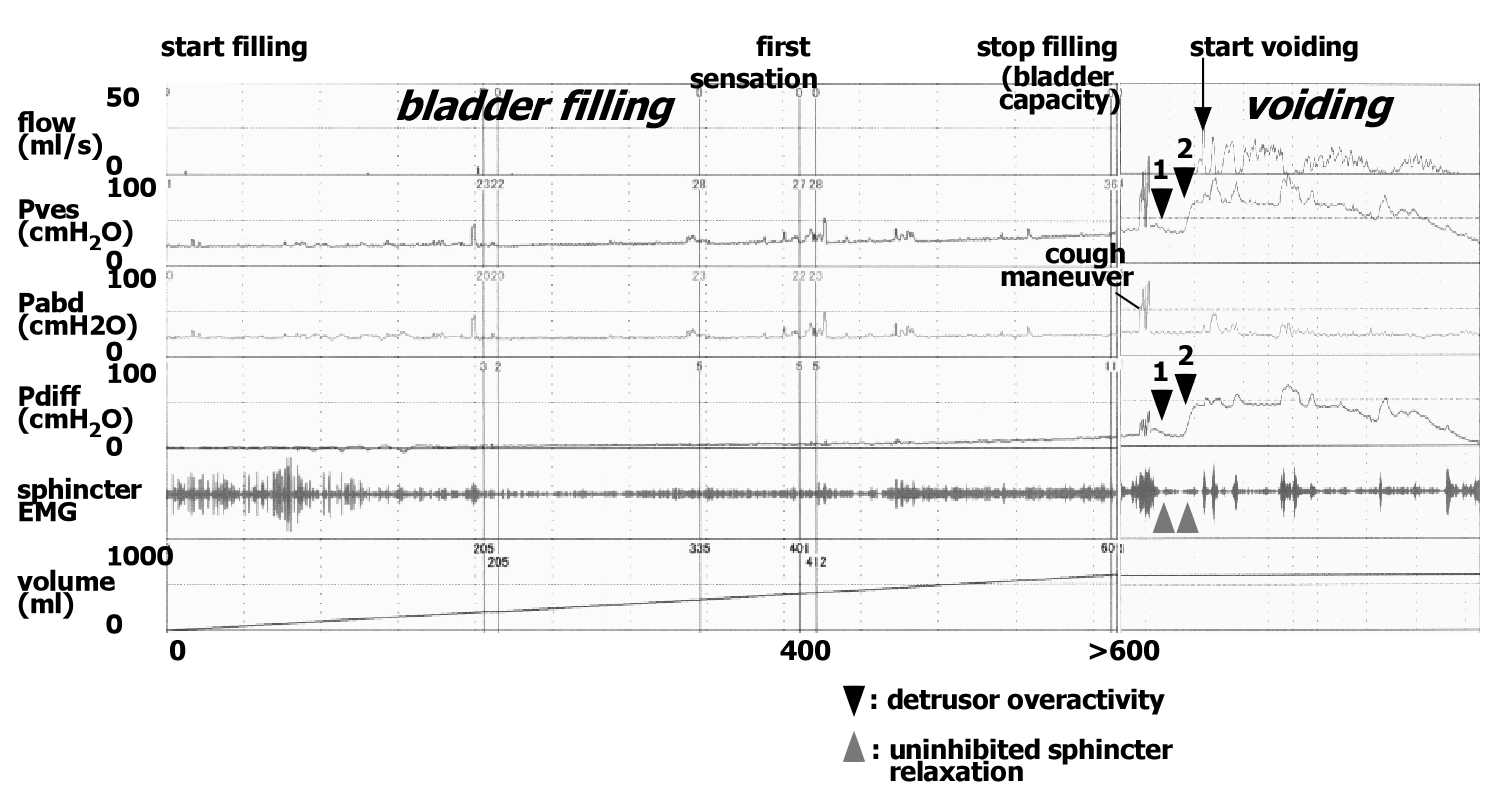
We described a case of a young man who, after recovery from herpes simplex encephalitis with lesions in the frontal and insular cortices, developed ‘unwitting’ urinary incontinence. A urodynamics revealed 1) markedly-decreased bladder sensation and 2) a biphasic bladder disorder, e.g., before the bladder volume reaches that to provoke detrusor overactivity (DO), without bladder sensation, he is unable to contract his bladder; after provoking DO, he leaks without post-void residual. After starting clean, intermittent self-catheterization, his bladder disorder ameliorated spontaneously. This might be one form of classical ‘Andrew and Nathan type’ frontal urodynamic abnormality.
##plugins.generic.paperbuzz.metrics##
参考
2 Andrew J, Nathan PW (1965). The cerebral control of micturition. Proc Roy Soc Med 58: 553-555.
3 Andrew J, Nathan PW, Spanos NC (1966). Disturbances of micturition and defaecation due to aneurysms of anterior communicating or anterior cerebral arteries. J Neurosurg 24: 1-10.
4 Wyndaele JJ (1993). Is impaired perception of bladder filling during cystometry a sign of neuropathy? Br J Urol 71: 270-273.
5 Tsunoyama K,Sakakibara R,Yamaguchi C,Uchiyama T,Yamamoto T,Yamanishi T,Takahashi O,Sugiyama M,Kishi M,Ogawa E (2011). Pathogenesis of reduced or increased bladder sensation. Neurourol Urodyn 30: 339-343.
6 Abrams P, Cardozo L, Fall M, Griffiths D, Rosier P, Ulmstein U, van Kerrenbroeck P, Victor A, Wein A (2002). The standardization of terminology of lower urinary tract function; report from the Standardization Subcommittee of the International Continence Society. Neurourol Urodynam 21: 167-178.
7 Sakakibara R, Uchiyama T, Yamanishi T, Kishi M (2009). Sphincter EMG as a diagnostic tool in autonomic disorders. Clin Auton Res 19: 20-31.
8 Sakakibara R, Hattori T, Fukutake T, Mori M, Yamanishi T, Yasuda K (1998). Micturitional disturbance in herpetic brainstem encephalitis; contribution of the pontine micturition center (PMC). J Neurol Neurosurg Psychiatry 64: 269-672.
9 Fowler CJ, Griffiths D, de Groat WC (2008). The neural control of micturition. Nat Rev Neurosci 9: 453-466.
10 Tai C,Wang J,Jin T,Wang P,Kim SG,Roppolo JR,de Groat WC (2009). Brain switch for reflex micturition control detected by FMRI in rats. J Neurophysiol. 102: 2719-2130.
11 de Groat WC, Wickens C (2013). Organization of the neural switching circuitry underlying reflex micturition. Acta Physiol (Oxf). 207: 66-84.
12 Griffiths DJ, Fowler CJ (2013). The micturition switch and its forebrain influences. Acta Physiol (Oxf). 207: 93-109.
13 Sakakibara R, Tateno F, Yano M, Takahashi O, Sugiyama M, Ogata T, Kishi M, Tsuyusaki Y, Yamamoto T, Uchiyama T, Yamanishi T, Shibata C (2013). Tolterodine activates the prefrontal cortex during bladder filling in oab patients: a real-time NIRS-urodynamics study. Neurourol Urodynam Article first published online : DOI:10.1002/nau.22471
14 Sakakibara R, Fowler CJ, Hattori T (1999). Voiding and MRI analysis of the brain. Int Urogynecol J Pelvic Floor Dysfunct. 10: 192-199.
15 Liao JM,Cheng CL,Lee SD,Chen GD,Chen KJ,Yang CH,Pan SF,Chen MJ,Huang PC,Lin TB (2006). Impaired micturition reflex caused by acute selective dorsal or ventral root(s) rhizotomy in anesthetized rats. Neurourol Urodyn. 25: 283-289.
Article Sidebar
Article Details
Authors who publish with the Bladder agree to the following terms:
- Authors retain copyright and grant the Bladder right of first publication with the work simultaneously licensed under a Creative Commons Attribution License that allows others to share the work with an acknowledgement of the work's authorship and initial publication in this journal.
- Authors are able to enter into separate, additional contractual arrangements for the non-exclusive distribution of the journal's published version of the work (e.g., post it to an institutional repository or publish it in a book), with an acknowledgement of its initial publication in this journal.
- Authors are permitted and encouraged to post their work online (e.g., in institutional repositories or on their website) prior to and during the submission process, as it can lead to productive exchanges, as well as earlier and greater citation of published work (See The Effect of Open Access).
##submission.authorWithAffiliation##
Assistent professor
##submission.authorWithAffiliation##
Associate Professor and Chair##submission.authorWithAffiliation##
Assistent professor##submission.authorWithAffiliation##
BSc##submission.authorWithAffiliation##
BSci##submission.authorWithAffiliation##
Lecturer##submission.authorWithAffiliation##
Assistent professor##submission.authorWithAffiliation##
Professor##submission.authorWithAffiliation##
Professor##submission.authorWithAffiliation##
Resident