Characterization of men with lower urinary tract dysfunction after surgical management of benign prostatic obstruction
Main Article Content
Keywords
摘要
Objective: To characterize the symptoms and urodynamic findings of men with lower urinary tract dysfunction after a transurethral resection of the prostate (TURP).
Materials and Methods: A total of 123 consecutive men with lower urinary tract dysfunction after surgical treatment for lower urinary tract symptoms (LUTS) were analyzed. Men with prostate cancer, stricture, multiple TURPs, radical prostatectomy or prostate cancer treatment were excluded. Parameters assessed by urodynamics included bladder capacity, detrusor contractibility, pressure flow study, and post void residual. Analysis of the variance was used to compare outcomes of urodynamic parameters between the primary diagnoses.
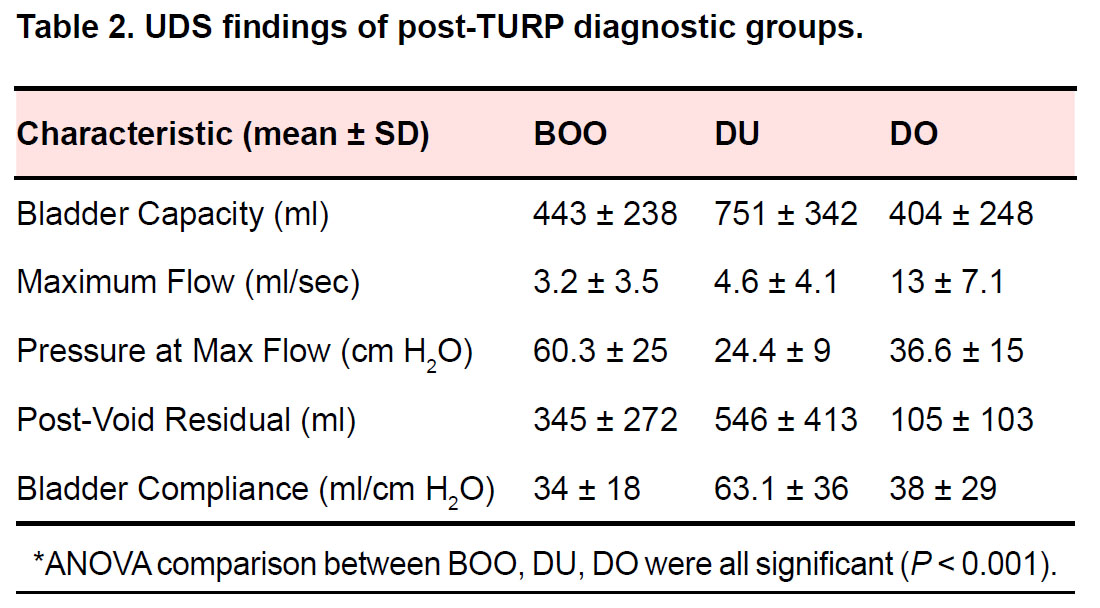
Results: Mean age at TURP was 68 years (range 39 to 88). Symptoms included frequency (68%), nocturia (53%), urgency (44%), and retention requiring catheterization (17%). A total of 72 men (59%) were diagnosed with bladder outlet obstruction (BOO), 30 (24%) with impaired detrusor contractility (DU), and 21 (17%) with detrusor over activity (DO). Among these groups, there was no difference in duration of recurrent symptoms, AUA symptom score, Quality of Life score, or prostate size. Maximum flow was significantly less and post-void residual significantly greater in both BOO and DU groups. Bladder capacity was significantly higher in DU.
Conclusions: In the modern era, bladder outlet obstruction was the most common cause of recurrent lower urinary tract dysfunction after surgical management of BPO.
##plugins.generic.paperbuzz.metrics##
参考
2. Nitti V, Kim Y, Combs A. Voiding dysfunction following transurethral resection of the prostate: symptoms and urodynamic findings. J Urol 1997;157:600-3.
3. Kang Y, Kim K, Seo Y, Lee K. Effect of transurethral resection of the prostate on storage symptoms in patients with benign prostatic hyperplasia of less than 30 ml. World J Mens Health 2013;31:64-9.
4. Gormley E, Griffiths D, McCracken P, Harrison G, McPhee M. Effect of transurethral resection of the prostate on detrusor instability and urge incontinence in elderly males. Neurourol Urodyn 1993;12:445-53.
5. Reynard J, Shearer R. Failure to void after transurethral resection of the prostate and mode of presentation. Urol 1999;53:336-9.
6. Schafer W, Abrams P, Liao L, et al. Good urodynamic practices: uroflowmetry, filling cystometry, and pressure-flow studies. Neurourol Urodyn 2002;21:261-74.
7. Abrams P, Cardozo L, Fall M, et al. The standardization of terminology of lower urinary tract function: report from the standardization sub-committee of the international continence society. Neurourol Urodyn 2002;21.
8. Schafer W. Analysis of bladder-outlet function with the linearized passive urethral resistance relation, linPURR, and a disease-specific approach for grading obstruction: from complex to simple. World J Urol 1995;13:47-58.
9. Osman N, Chapple C, Abrams P, et al. Detrusor underactivity and the underactive bladder: a new clinical entity? a review of current terminology, definitions, epidemiology, aetiology, and diagnosis. Eur Urol 2014;65:389-98.
10. Van Venrooij G, Van Melick H, Eckhardt M, Boon T. Correlations of urodynamic changes with changes in symptoms and well-being after transurethral resection of the prostate. J Urol 2002;168:605-9.
11. Transurethral resection of the prostate. 2012. (Accessed at http://emedicine.medscape.com/article/449781-overview.)
12. Djavan B, Madersbacher S, Klingler C, Marberger M. Urodynamic assessment of patients with acute urinary retention: is treatment failure after prostatectomy predictable? J Urol 1997;158:1829-33.
13. Martin M. Effect of diabetes on lower urinary tract symptoms in patients with benign prostatic hyperplasia. J Urol 2000;163:1725-9.
14. Rohrmann S, Smit E, Giovannucci E, Platz E. Association between markers of the metabolic syndrome and lower urinary tract symptoms in the Third National Health and Nutrition Examination Survey (NHANES III). Int J Obes 2005;29:310-6.
15. Rocco B, Albo G, Ferreira R, et al. Recent advances in the surgical treatment of benign prostatic hyperplasia. Ther Adv Urol 2011;3:263-72.
Article Sidebar
Article Details
Authors who publish with the Bladder agree to the following terms:
- Authors retain copyright and grant the Bladder right of first publication with the work simultaneously licensed under a Creative Commons Attribution License that allows others to share the work with an acknowledgement of the work's authorship and initial publication in this journal.
- Authors are able to enter into separate, additional contractual arrangements for the non-exclusive distribution of the journal's published version of the work (e.g., post it to an institutional repository or publish it in a book), with an acknowledgement of its initial publication in this journal.
- Authors are permitted and encouraged to post their work online (e.g., in institutional repositories or on their website) prior to and during the submission process, as it can lead to productive exchanges, as well as earlier and greater citation of published work (See The Effect of Open Access).